Need Help? Email: [email protected]
For Anyone Who Wants To Make Real Money With Automated Trading Systems
The Six-Step Evaluation Method That Exposes Whether An Algorithmic Trading System Will Build Your Wealth Or Destroy Your Account — In As Little As Five Minutes — Before A Single Dollar Is At Risk
While also knowing exactly what the smooth equity curve is hiding before a single dollar goes in... spotting the one structural fingerprint that a 80% win rate is actually costing you money... and finally evaluating every automated trading system the way hedge fund allocators do — not the way the marketing page was designed to make you feel.
This 7-Minute Revolutionary System Has Made Over $2.1 Million In The Last 30 Days
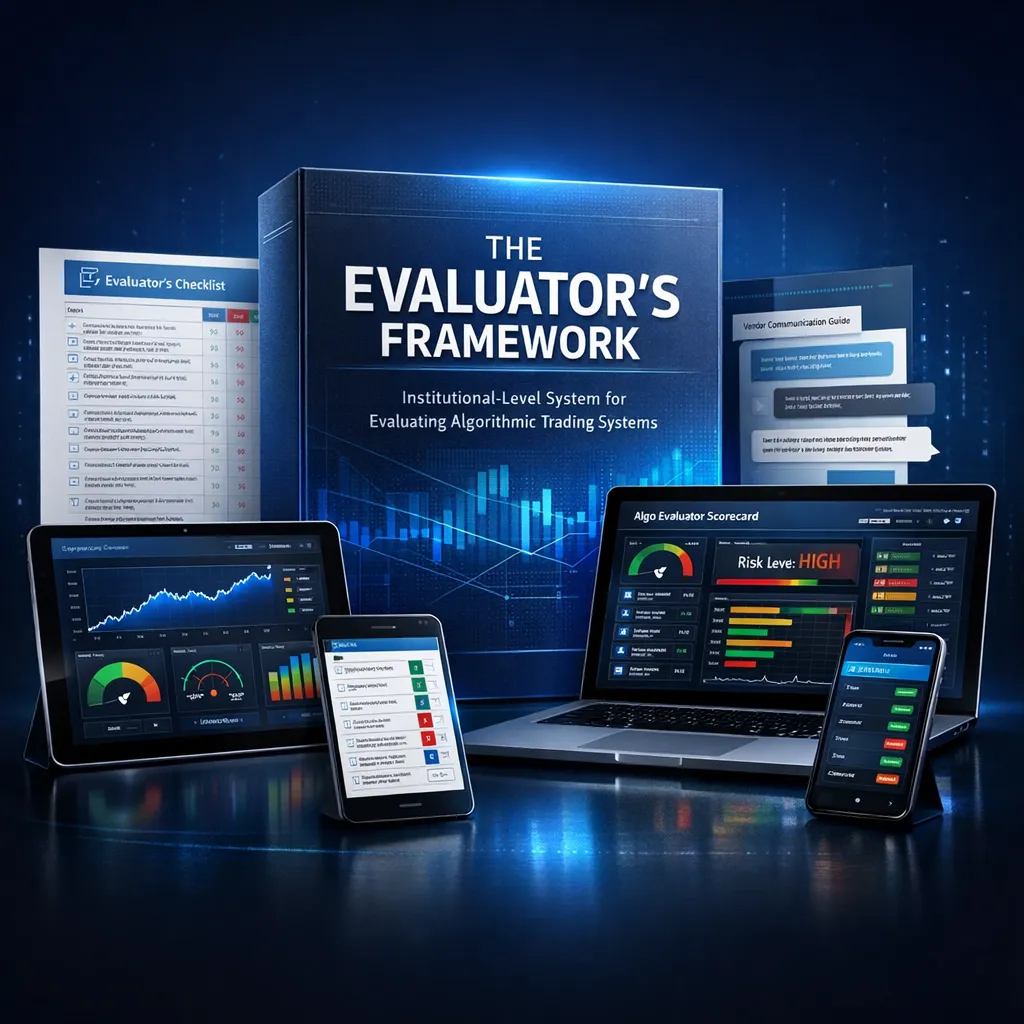
What Is The Evaluator's Framework?
The Evaluator's Framework is a counterintuitive approach to evaluating any automated trading system, that allows you to see — in plain language and in about twenty minutes — exactly what a system is made of underneath its marketing, without staring at code, wiring money into something you can't fully assess, or trusting a track record you don't have the tools to interpret.
We achieve this by teaching you to read the structural fingerprints of how a system is actually built — not how it's being sold — without needing a quantitative research background, an engineering degree, or twenty years of market experience.
And as a result... this frees you up to make confident, clear-headed investment decisions in a space that genuinely can change your financial life — this is The Evaluator's Framework.
Price Doubles Soon...

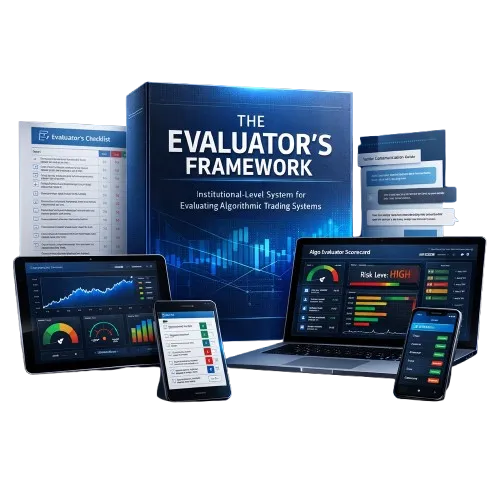
$7.00
(YOU’RE SAVING $631.00)
LIST PRICE $638
Grab Your Copy For $638 Just $7.00!
Get started in the next 2 minutes!

The Evaluator's Framework Is A Shortcut
Before I built The Evaluator's Framework, I watched someone lose $400,000 that I could have helped him protect.
His name is Chance. He'd invested in a system with polished marketing and real social proof. Other users were reporting great results. The equity curve was smooth. The numbers looked professional.
Everything checked out at the surface level.
I had been warning him for months. Not vaguely. Specifically. I could see exactly what was happening inside that system. But Chance didn't have the framework to understand why my warning meant anything. He could hear "be careful." He couldn't see what I was seeing.
So he scaled. $25,500 to $150,000. $150,000 to $400,000 plus.
Then the day came.
Account gone.
And the most painful part wasn't watching it happen. It was knowing — with complete certainty — that it was identifiable before a single dollar went in. Not in hindsight. In advance. With the right evaluation tools.
That's what The Evaluator's Framework gives you.
InCLUDED WITH YOUR ORDER
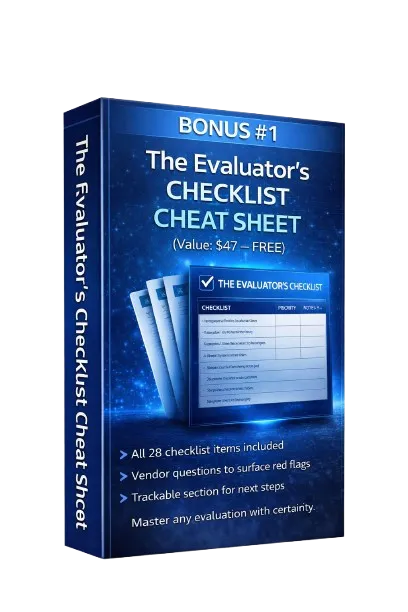
BONUS #1: The Evaluator's Checklist Cheat Sheet
The complete 29-item structural evaluation in a single print-ready reference document. Every check. Every risk category. Plain-language descriptions. Mark it as you go.
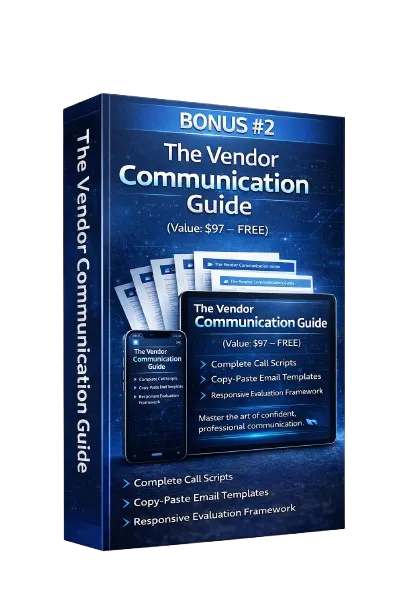
BONUS #2: The Vendor Communication Guide
Complete call scripts, five copy-paste email templates, response evaluation framework, and the mindset guide that gives you the confidence to ask any vendor any question — professionally, clearly, and without confrontation.
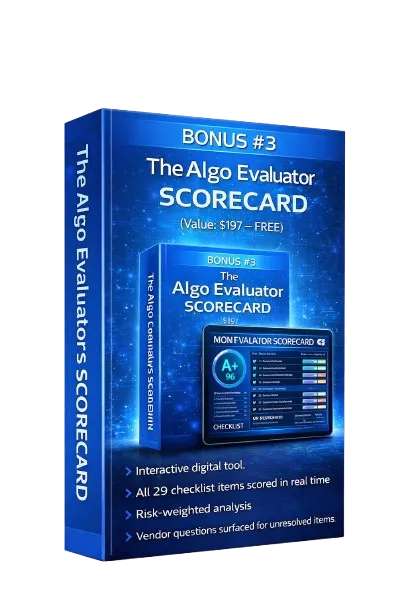
BONUS #3: The Algo Evaluator Scorecard
Interactive digital tool. All 29 checklist items scored in real time with risk-weighted analysis, course-grounded explanations for every flag, and vendor questions surfaced for every unresolved item. Your complete evaluation in one place.
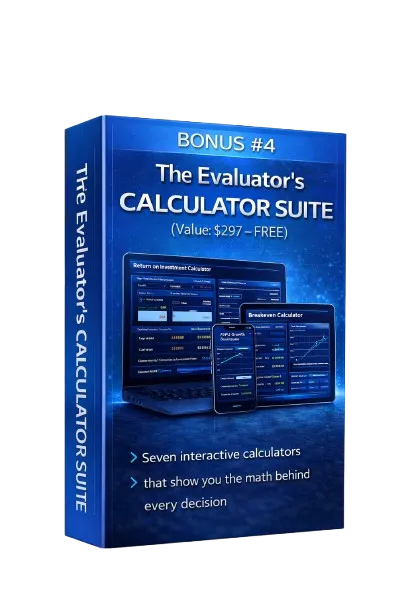
BONUS #4: The Evaluator's Calculator Suite
Seven interactive calculators that show you the math behind every decision — fragility analysis, loss clustering stress tests, Sharpe ratio benchmarking, track record confidence scoring, and more — without requiring you to know any math. Real numbers. Real-time results. Real clarity.
AI Prompts Library
Every AI prompt I use to compress months of work into hours
Here's How A Semi-Professional Poker Player Who Became A Top-Ranked Systems Engineer, Then An Eight-Figure Day Trader, Then The Founder Of A Quantitative Trading Firm That Analyzes 64 Billion Data Points — Built The First Evaluation Framework That Lets Any Investor See What The Marketing Page Was Designed To Hide... In About Twenty Minutes... Before A Dollar Is At Risk
This Is Something Completely New, Completely Different, Completely Unlike Anything You've Seen In This Space — Read The Story Below To See The Evaluator's Framework
Dear Future Evaluator's Framework Owner,
From: The laptop of Brian Devens
Re: The one equation sophisticated investors use to evaluate every system they consider — and why most investors have never been taught it exists (and why that gap is costing people everything)
Would it surprise you to learn that a trading system with a 90% win rate can mathematically guarantee that you lose money — and that I can show you exactly why in about sixty seconds?
Skeptical?
Good. You should be skeptical. You've probably already seen your share of impressive-looking numbers in this space.
So let me earn your trust before I ask for anything.
so let me prove it to you

But first, read this disclaimer:
I have the benefit of over seventeen years across poker, systems engineering, discretionary markets, and institutional quantitative research — including building strategies, a NASDAQ futures system with over seven years of live development, $1M+ invested in research, and 64 billion data points analyzed. Performance independently audited by a CIPM-certified firm — the same standard used by major hedge funds.
The examples in this course represent real people and real documented losses.
With that said — let me show you what I found.
And I Found It By Using A Counterintuitive Evaluation Model That I'm About To Share With You On This Very Page...
The same Evaluator's Framework that investors from across the US, Europe, and the Middle East are now using to know — before committing a dollar — which systems are structurally sound and which ones are storing losses in the account right now, waiting for the event that will take everything...
...And in turn protecting their capital from the exact type of catastrophic, total-account losses that have been destroying retail investors in this space for years...
...All while spending less time guessing and more time making clear, informed decisions based on the same criteria institutional allocators actually use...
...And best of all, doing it without needing a quantitative research background, an engineering degree, or permission from anyone.
Just Like Chance, Who Scaled From $25,500 Into A Single System All The Way To $400,000 — And Watched It Disappear In A Single Event
The system looked legitimate. Great marketing. Real social proof from other users. A clean equity curve. Every surface metric checked out.
It worked. Until the one day it didn't.
But the hidden benefit — the part that matters now — isn't the loss. It's what Chance has today.
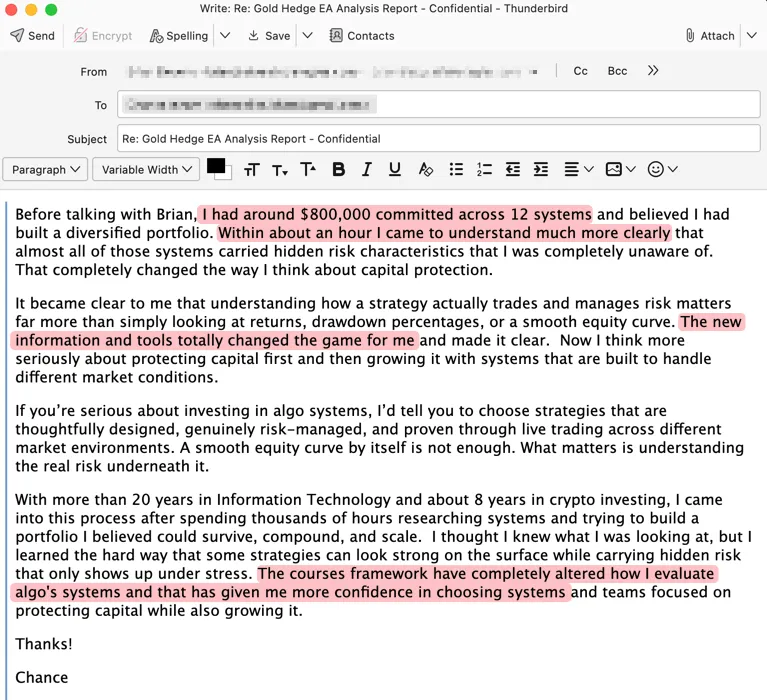
Today, Chance runs one real system. Sustainable returns. Two years and counting. No catastrophes. Because now he knows exactly what to look for before he commits capital. He doesn't guess. He evaluates.
And Chance isn't the only one.
This Is Orlando, Who Found A "Gold Bot" Claiming 25-50% Monthly Returns, No Losing Months, And Drawdowns Under 15%...
...And within four months, $45,000 of his savings was gone.
I didn't need to see the marketing page. I didn't need to understand the strategy. The numbers alone told me everything. Returns like that, consistently, with drawdowns that low? That is not a real risk profile. It's a number that exists in a completely different universe from anything documented in audited institutional performance.
But Orlando didn't have the tools to see it. And four months later, the account was empty.
Today, Orlando spots high-risk systems in seconds. He sends me messages occasionally about systems showing up in his feed and says "I know exactly what this is." No more wasted capital. No more wasted time. He recently bought a boat. He's enjoying Miami.
That's money that used to go into systems that blew up.
And There Was Adam, Who Paid $20,000 For A System With A High Win Rate, Professional Marketing, AI Language, And Regular Updates — Everything That Makes A System Look Credible
The losses were 10 times the size of the wins. He lost another $20,000 in account losses before the vendor disappeared entirely. $40,000 total.
Today, Adam knows exactly what a broken risk profile looks like. He can look at a high win rate and immediately ask the right follow-up question. He's never made that mistake again.
Soon After, Cameron Posted This In Our Private FB Group:
And even though getting a [INSERT RESULT THEY GOT], that's not the best part...
The best part is [INSERT HIDDEN BENEFIT].
That's right, [EXPLAIN THE HIDDEN BENEFIT FURTHER].
And [INSERT TESTIMONIAL NAME] isn’t the only one either…
...And soon [INSERT RESULT THEY GOT]...
Here’s a post he posted in our private FB Community (which you will have access to once you join the program)...
Here’s another "First Deal" Challenge owner who started using these strategies…
Chance, Orlando, And Adam Represent A Growing Community Of Investors Who Are Doing Things Differently Now.
And you can BET...
The Evaluator's Framework is unlike any evaluation method you've seen before.
…This is something completely different, because…
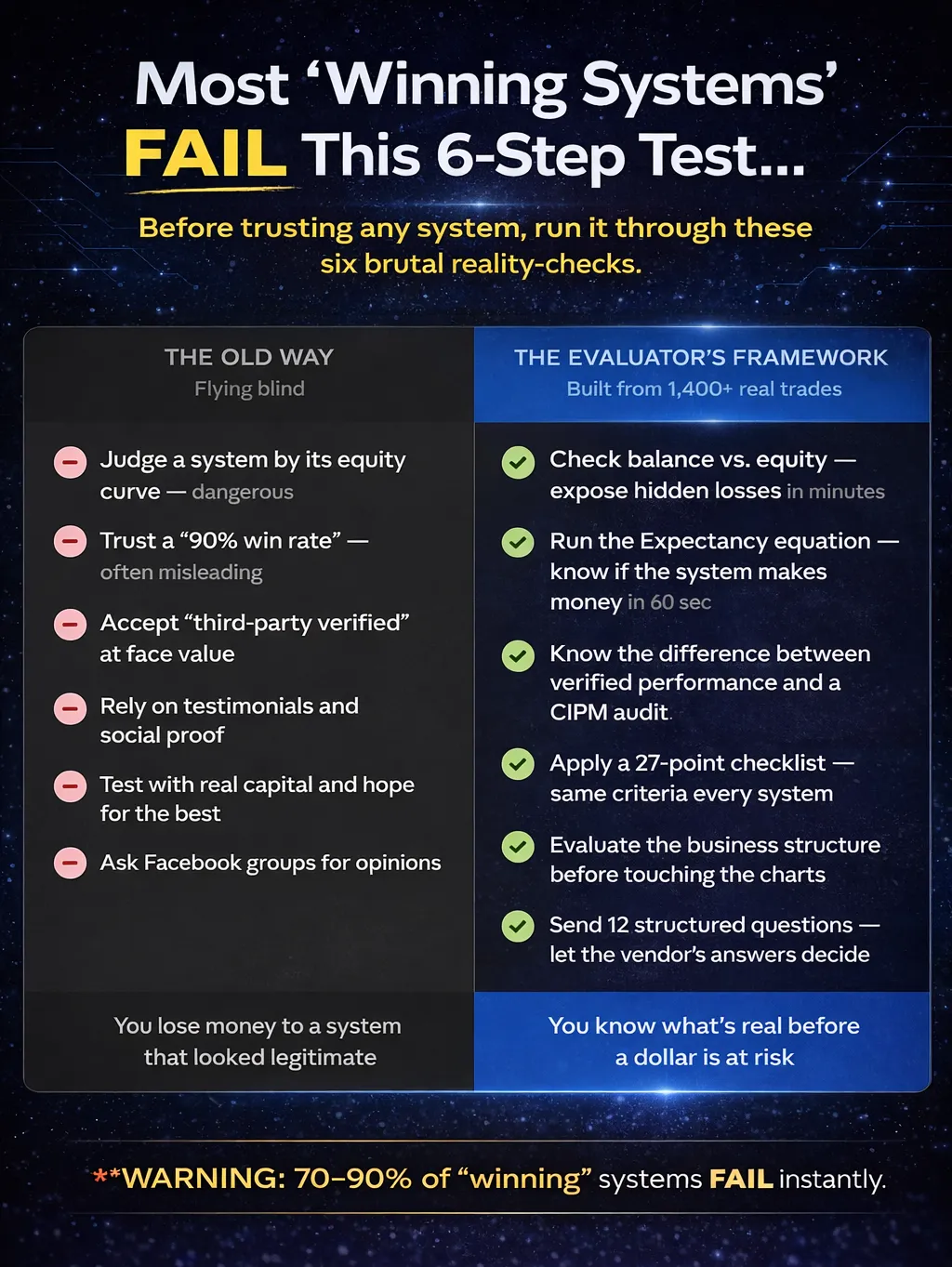
❌ We don't focus on the smooth equity curve — because the smoothest, most perfect-looking chart you've ever seen is almost certainly the most dangerous system you'll ever encounter. There's a specific reason why. It has a name. And once you learn it, you'll never look at a clean equity curve the same way.
❌ We don't focus on win rate — because an 81% win rate nearly destroyed one of the most experienced traders I've ever worked with. A 44% win rate made him wealthy. One number tells you which is which. It takes sixty seconds to learn. The industry has a very specific reason you've never been taught it.
❌ We don't focus on testimonials — because Chance's system had real testimonials from real people making real money. Every one of them lost their accounts on the same day. The testimonials weren't fake. The risk was invisible. There's a specific reason that's possible — and it keeps happening.
❌ We don't focus on "verified" performance — because that word spans an enormous range. One end is essentially meaningless. The other end is the standard used to audit billion-dollar hedge funds. You can tell the difference in about sixty seconds. Most investors never learn how.
❌ We don't focus on AI claims — because "our AI gets smarter with more users" is true in facial recognition. In financial markets, it inverts the truth. One concept explains why. It takes two minutes to understand. And once you have it, every AI claim in this space either holds up or falls apart.
In fact, we rarely, if ever, accept a system's marketing at face value.
Instead, we evaluate the structure underneath. The mechanics that determine whether a system is built to last — or built to fail on a schedule, looking perfect right up until it doesn't.
Like I said…
This Is Completely Different. And I Know That's True Because It Changed Everything For Me.
…and I know that’s true…
Because it changed everything for me.
The Evaluator's Framework allowed me to get rid of 99% of the confusion that makes this space feel impossible:
✅ Staring at equity curves with no framework for what they're actually showing me
✅ Being impressed by win rates without understanding that a 90% win rate can guarantee you lose money
✅ Paralysis between systems that ALL look legitimate on the surface
✅ Feeling like you need a PhD or a Bloomberg terminal to participate in this space with any real confidence
✅ Watching people get burned by risks that were identifiable in advance — by the right tools
The Evaluator's Framework freed me from all of that. And it let me finally take what I know from the institutional side and give it to investors who deserve it.
Here's What This Space Looks Like Without The Right Tools. I Call It The "Equity Curve Of Doom":
Step 1 - Find a system with strong returns and a smooth equity curve. Feel excited.
Step 2 - Check the "verified" track record. See the win rate. Feel reassured.
Step 3 - Read the testimonials. See real people with real results. Feel even more confident.
Step 4 - Invest a smaller amount to test it. It works. Feel validated.
Step 5 - Scale up because the results continue. Feel smart.
Step 6 - Notice the drawdown. Tell yourself it's normal variance. Feel nervous.
Step 7 - Watch the system either blow up in a single event, slowly bleed the account with losses that dwarf the wins, or have the vendor disappear entirely when things go wrong.
Step 8 - Start over with less capital, more skepticism, and still no framework for why it happened.
That cycle doesn't just destroy accounts — it destroys people's confidence in a space that, with the right systems, genuinely works.
Here's what kept eating at me.
I had spent years learning how to see through these systems. I could look at a marketing page and diagnose the structural risk in about twenty seconds. I could tell you whether a system was storing losses, whether the risk-to-reward was inverted, whether the track record would survive statistical scrutiny — all of it. Fast. Accurately. Every time.
And none of that helped the people who actually needed it.
Because the criteria I was using — the same criteria every institutional allocator uses before they commit a dollar — had never been organized in a way that a retail investor could apply.
It lived inside the heads of people like me and the professionals I'd worked with. It lived in institutional research papers nobody outside the industry reads. It lived in conversations that happen behind closed doors at hedge funds and quant firms.
Meanwhile, investors were out there evaluating systems with the only tools available to them — marketing pages, published return numbers, win rates, testimonials, dashboards — and getting destroyed by risks that were identifiable in advance. Not by guessing. Not by intuition. By specific, structured criteria that professionals use every single day.
The gap wasn't intelligence. The gap wasn't effort. Chance was smart. Orlando did his homework. Adam spent $20,000 because he took it seriously. The gap was that nobody had ever given them the actual evaluation tools.
That's when I made the decision. Not to teach people to trade. Not to sell a system. To take everything I'd learned — from poker, from engineering, from professional trading, from seven years inside institutional algorithmic research — and organize it into a framework that any investor could pick up and apply immediately. Plain language. No math degree required. No Bloomberg terminal. Just the six structural questions that actually determine whether a system is real or manufactured.
And I Put This Entire System Into A Mini Course Called The Evaluator's Framework — And You Can Start Going Through It In The Next Few Minutes
But before you do, let me tell you who I am and how this came to be.
My name is Brian Devens.
You probably haven't heard of me. That's by design. I'm not building a personal brand. I don't do YouTube thumbnails with lamborghinis. I don't sell a $20,000 bot.
What I am is someone who has spent seventeen years on the inside of this industry — across poker, engineering, professional trading, and institutional quantitative research — and who reached a point where watching preventable losses happen to smart, careful people became something I couldn't ignore anymore.
Let me show you how all of that connects to the framework you're about to get. And I'll say this upfront — nothing I'm about to share requires you to understand the math behind any of it. I did that part. You're getting the shortcuts it produced.
It Started With Probability — Not Finance
Before I ever looked at a market, I was obsessed with uncertainty. Not philosophically — mathematically.
At seventeen, I was a semi-professional poker player earning six figures in a single year. Poker taught me the one principle that separates professionals from everyone else in any probabilistic field: the game is never about being right on any single hand. It's about being positioned correctly across hundreds of decisions under uncertainty — and letting the math resolve over time.
That principle is the backbone of this entire framework.
From there, I went to Virginia Tech — ranked Top 5 in the nation for engineering. I specialized in probabilistic and stochastic modeling: in plain language, the mathematics of building systems that work not because they predict the future, but because they're structured to handle any outcome.
At one point I was ranked #1 out of 4,000 students in my engineering program.
That foundation — applied probability, systems architecture, decision-making under incomplete information — is what everything I'm about to teach you is built on. Not market opinions. Not chart patterns. The structural mathematics of how systems succeed or fail.
And here's what matters for you: I spent seventeen years and over a million dollars learning this the hard way. You don't need any of it. You need the six shortcuts it produced — and I'm going to hand them to you in plain language that anyone can apply.
Then Came The Markets — And The Ceiling That Changed Everything
By my late twenties, I was a professional eight-figure day trader, controlling significant market positions alongside other eight- and nine-figure professionals. Over a decade of live-market experience at the highest level.
I was making real money. I was also exhausted — in front of screens all day, making high-stakes decisions for hours, knowing that my own psychology was the single biggest variable in my results.
I was the system. Manually. Every day. And no matter how sharp I was, human execution had a structural limit.
I knew what it looked like when a system did the work instead of a person. I'd co-founded multiple eight-figure companies across industries, and every successful one was built on the same principle: engineer the system so it doesn't depend on the human being perfect every day.
Then one afternoon, everything shifted.
The Afternoon That Started Everything
I was sitting with a quant mentor of mine — a man who'd spent decades building the kind of algorithmic trading systems that hedge funds use to manage hundreds of millions of dollars. He'd built a fortune north of eighty million doing it. Not by trading manually. By engineering systems that traded for him.
We were in front of his setup: screens everywhere, algorithms running.
While we talked, his system was quietly generating tens of thousands of dollars. Without him touching a thing.
He wasn't managing it. He wasn't monitoring it. He was living his life. And the system was doing what it was built to do.
I looked at what I had — eight figures, six monitors, twelve-hour days — and I looked at what he had — engineered wealth that ran while he lived — and the gap was everything.
But it wasn't the money that changed my trajectory. It was something he said.
I'd pulled up a system I'd been evaluating — impressive returns, beautiful equity curve, barely any drawdowns. The kind of chart that makes you want to wire money immediately.
He looked at it for about three seconds.
Then he said something I will never forget:
"You see that equity curve? The smooth one that goes up and to the right with barely a dip? That's not what safety looks like. That's what hidden risk looks like. A real system shows you its losses. A dangerous system hides them — and the smoother the curve, the more it's hiding."
I pushed back. I had the data. I had the numbers. The drawdown was published right there — 4.2%.
He laughed. Not unkindly. And he said: "That's the number they're showing you. The real number is somewhere else entirely. And if you don't know how both numbers can exist on the same account on the same day, you're not evaluating this system. You're reading its marketing page."
That one conversation reframed everything I thought I knew about evaluating trading systems.
And it planted a question I couldn't let go of: if the thing that looks safest is actually the most dangerous — if the metric every investor checks first is the one most easily manipulated — then what are you supposed to look at instead?
It took me years to fully answer that question. But the answer became the foundation of every step in The Evaluator's Framework.
I Spent The Next Seven Years Learning It From The Inside
I went deep — into the world of algorithmic systems and hedge fund-level quantitative research. Quantitative just means math-driven — using data and probability instead of gut feelings and chart patterns. It's the same technology that gets talked about constantly in this space, except I was on the inside of it, actually building it. Not marketing it. Not selling it. Engineering it.
I invested over $1 million and analyzed more than 64 billion data points. I worked with an Oxford-trained theoretical physicist, a quant finance specialist from one of the top finance programs in the world, and institutional risk professionals across four countries — the kind of people hedge funds pay seven figures to keep on staff.
I built algorithmic systems. Real ones. And along the way, I built some that had structural weaknesses — and I watched them break. I learned what overfitting really looks like, not from a textbook but from watching my own models fail. I learned why certain architectures are fundamentally fragile, because I built some of them early on and thought I could get away with it.
There were periods where my team and I seriously questioned whether we were going in the right direction at all. The problems in quantitative finance are among the most complex in applied mathematics. The data is limited. The signal-to-noise ratio is terrible. The margin for error is essentially zero. Most people who enter this space don't survive that phase.
We survived it. And those years produced something no shortcut can replicate: I've been on both sides. I've built the fragile systems. I've seen what breaks and exactly why. And I've spent years engineering the solutions.
Every red flag I teach in this course — I know it's real because I've lived on both sides of it. Not theory. Direct experience.
But here's the thing that matters for you — and I want to be very clear about this: you don't need to go through any of that. You don't need to spend seven years in quantitative research. You don't need to understand the mathematics of stochastic modeling. You don't need to build a single algorithm.
I already did all of that. What you need is the output — the six steps, the specific things to look for, and the plain-language framework that tells you exactly what's real and what isn't. The hardest concept in this entire course can be fully understood in under five minutes. Most of them are faster than that.
And Then I Started Seeing The Same Structural Flaws Everywhere
As I went deeper into the institutional side, something started making me increasingly angry.
The same structural weaknesses I'd learned to identify — the ones that break systems, that hide risk, that manufacture the appearance of safety — were everywhere in the retail algorithmic trading space. Not hidden. Not subtle. Everywhere.
Systems being marketed to regular investors that I could diagnose in seconds. Smooth equity curves hiding risk that hadn't materialized yet. High win rates that, if you understood one equation, were actually mathematical proof the system was losing money. Track records that wouldn't survive five minutes of statistical scrutiny. AI claims borrowed from industries where the term actually means something.
And investors — smart, careful, hardworking people — were pouring their savings into these systems because nobody had ever given them the tools to see what was underneath.
Chance's $400,000 loss? Identifiable before a dollar went in. Orlando's "Gold Bot"? Diagnosable from the marketing page alone — I didn't need to see the strategy, I didn't need to understand the code. The numbers told me everything in about twenty seconds. Adam's $40,000 system? It had a structural fingerprint that any institutional researcher would have flagged in minutes.
Not in hindsight. In advance. With the right evaluation criteria.
The criteria existed. Institutional allocators use it every day. Quantitative researchers apply it before they commit a dollar to anything.
But nobody had ever organized it into something a retail investor could actually use.
That gap — between what professionals know and what retail investors are given — is where this entire industry's worst damage happens. And it's the gap this framework closes.
That's What The Evaluator's Framework Is
Everything I learned — from poker, from engineering, from a decade of professional trading, from seven years inside institutional quantitative research, from building systems that broke and systems that worked, from sitting across from a man worth eighty million dollars who told me the smoothest equity curve in the room was the most dangerous thing in it — distilled into six steps that any investor can apply in about five minutes.
Most systems don't survive past step two. Some fail in twenty seconds. The ones that survive all six steps are a very short list — and that list is where your money belongs.
I didn't build this framework to sell courses. I built it because I got tired of watching people lose money to risks that were identifiable in advance — and knowing that the tools to see those risks existed but had never been made accessible to the people who needed them most.
There is one equation — one — that separates how institutional allocators evaluate systems from how everyone else does it. It takes about sixty seconds to learn. It's been available for decades. And the automated trading industry has a very specific reason for making sure you've never been taught it.
There are eight mathematical techniques used across this space to make bad systems look exceptional. Most investors fall for at least three without knowing it.
There is a single question that every legitimate algo firm will answer clearly and specifically — and every illegitimate firm will either dodge, deflect, or go silent on.
All of it is inside this course. In plain language. No finance degree required. No Bloomberg terminal. No twenty years of painful losses to figure it out.
This is that access.
And The Result Of Using This Framework?
Spreading joy around our community one brick at a time, while running a profitable business all at the same time.
Which Naturally Leads To…
You stop guessing. You stop second-guessing. You stop cycling through marketing pages wondering which one is telling the truth.
But here's what most people don't expect.
Avoiding bad systems isn't the transformation. It's the starting line.
The real transformation is what happens after the bad options are gone.
Because once you can see which systems are structurally broken — something else comes into focus.
You start seeing which systems are structurally sound.
Which ones have real edge.
Which ones are built to compound capital through any market environment — not just the easy ones.
That's when everything changes.
I've watched this happen for over a decade. Someone learns this framework. They eliminate the noise. And for the first time, they can clearly see the difference between a system that's going to take their money and a system that's going to change their financial life.
They stop going backwards.
They stop bleeding capital into things that were never going to work.
They start compounding. Real compounding. The kind that builds wealth while they live their life.
That's the difference between the 99% of investors in this space who churn through system after system — losing money, losing confidence, losing time — and the 1% who are quietly beating the market in ways most people don't think are possible.
The 1% aren't luckier. They aren't smarter.
They have better criteria. That's it.
This framework doesn't just protect your capital. It clears the path to the system that actually deserves it.
And once you find that system — the right system, the real one — that's when the lifestyle you came to this space looking for stops being a fantasy and starts being a plan.
Every system you evaluate for the rest of your investing life — you'll have this framework.
That skill is permanent. And it's the one thing that separates the investors who eventually win in this space from the ones who never stop losing.
How Many Approaches To Evaluating Algorithmic Systems Have You Seen Come And Go?
People ask in Facebook groups and get conflicting opinions from strangers who've all lost money differently...
Or they Google the system name and find cherry-picked reviews posted by affiliates who earn a commission on the sale...
Or they run it for a few months while it's still in the "working phase," then watch it fail when market conditions shift in a way the system was never built to survive...
My framework has been consistent across years of development and real institutional research.
Every system that failed had a detectable structural signature.
Every system that held up could pass a structured evaluation. That relationship is not random — it's the entire basis of this course.
Now I'm Going To Share Something A Little Uncomfortable.
I am giving away institutional-level evaluation criteria for seven dollars.
The vendors selling overpriced systems would prefer you didn't have this.
And most "how to trade" courses out there are making significant money teaching surface-level tactics that don't actually protect your capital — because an educated investor stops buying bad systems, and bad systems are where a lot of this industry's revenue lives.
The #1 Mistake Every Investor In This Space Makes Is Evaluating Returns Instead Of Risk Structure.
Here's why it matters:
There are two types of investors in this space.
There are "Return Chasers" — and there are "Structure Evaluators".
For a long time, the only tool most investors have is return chasing.
Return Chasers look for the system with the best historical performance and treat the equity curve as the signal that it's safe. Their strategy is to find the biggest, smoothest number and trust it.
And by focusing on that strategy, they spend enormous amounts of time on:
✅ Comparing win rates without understanding that a 90% win rate can mathematically guarantee you lose money
✅ Reading "verified" track records without knowing whether "verified" means anything at all in that specific context
✅ Treating a smooth equity curve as evidence of safety — when a smooth equity curve is actually the primary visual signature of the most dangerous risk category in this space
✅ Being impressed by AI language and "third-party audited" language without the tools to evaluate what those phrases actually prove
The problem isn't the effort. The problem is that none of these metrics tell you whether the risk is bounded, transparent, and manageable — or hidden, invisible, and compounding.
Bounded, visible risk is how real returns are generated. Hidden risk is what destroys capital.
Structure Evaluators don't get taken by what I call Warehoused Risk. They don't confuse a sawtooth equity pattern for normal variance. They don't get fooled by the four specific False Assurance signals that make every dangerous system feel safe.
I explain everything in The Evaluator's Framework — a comprehensive mini course that teaches you the six-step evaluation framework in plain language, with tools you can apply immediately.
So Here's The Idea Behind The Evaluator's Framework Model
Right now, the automated trading space is growing rapidly — and with that growth, the number of systems being marketed to retail investors has expanded dramatically. Bot. Algorithm. Quantitative model. AI. The words are used interchangeably, and they don't mean the same thing. Simple rule-based scripts. Sophisticated algorithms with genuine research behind them. And everything in between, all dressed in the same polished marketing language.
This has created a gap that nobody is filling at the retail investor level. Institutional researchers have the criteria. Retail investors don't. And every marketing page in this space is designed to exploit that gap.
Most investors looking at these systems right now are evaluating returns. That's the visible half. The half every vendor wants you focused on. Sophisticated investors evaluate risk-adjusted returns — how much return per unit of risk — and to do that, you need to see the risk side of the equation clearly.
That's what The Evaluator's Framework makes possible.
And what's genuinely exciting is that once you have it, those same marketing platforms — the ones that used to confuse and overwhelm you — become tools. Because now you know how to read them correctly. The metrics are inputs to your analysis, not the analysis itself.
Given the choice, every investor who has lost money in this space would choose to have run a real structural evaluation before committing capital rather than after.
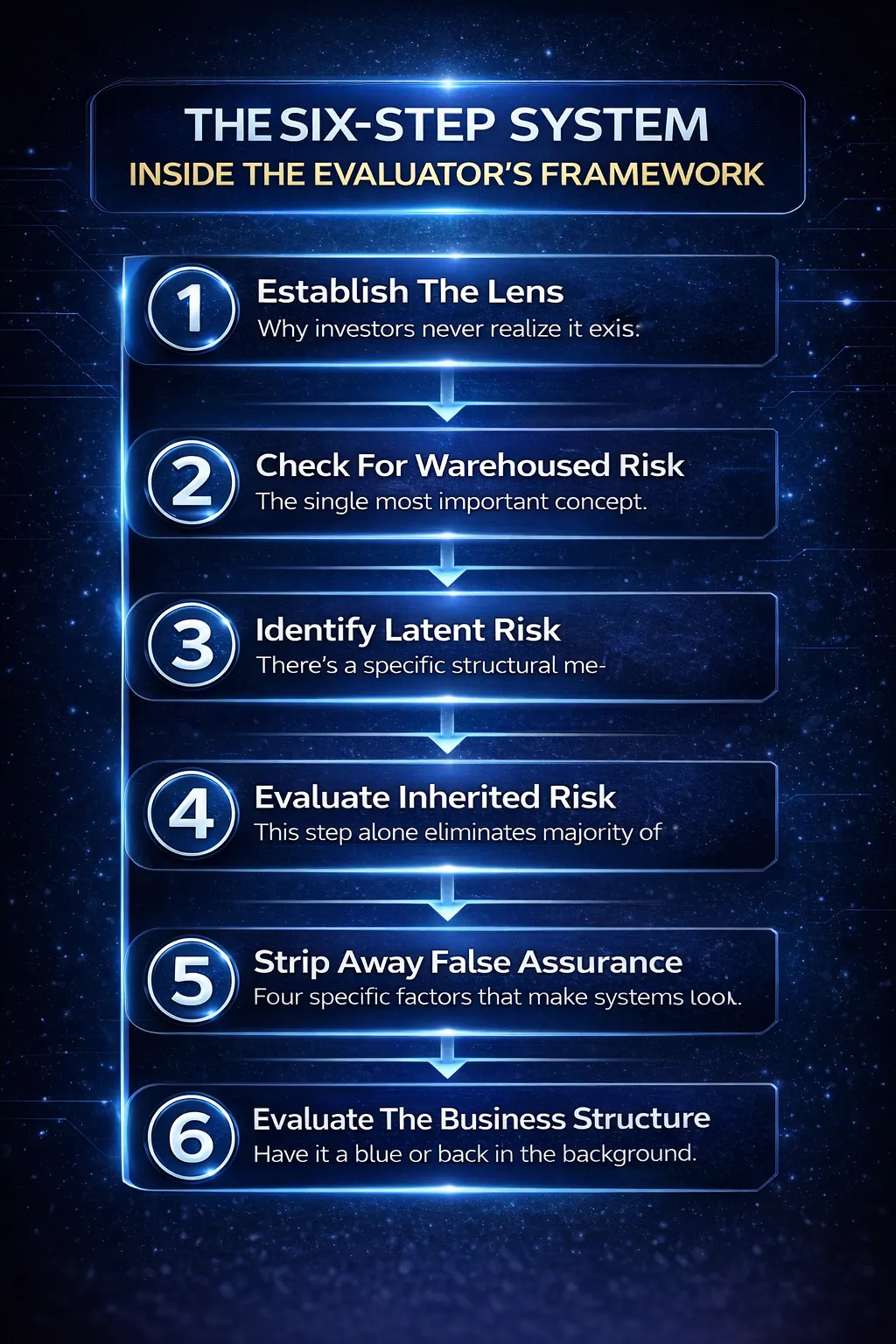
The Evaluator's Framework does this in six structured steps.
When You Evaluate Any System Using This Model, The Results Are Clear And Repeatable.
Compare that to the old way — where every evaluation is a gut feeling dressed up in screenshots and social proof.
I'm not saying following your instincts is wrong.
What I'm saying is that if your goal is to protect your capital and participate confidently in automated trading, your instincts alone may be exactly the thing holding you back. Because your instincts were shaped by the same marketing pages that were designed to bypass them.
The old way requires trusting people who have a financial incentive to mislead you, whether intentionally or not.
The Evaluator's Framework just requires twenty minutes and a structured, repeatable process — and gives you institutional-level clarity every time.
And You Know What? I'll Stake My Entire Reputation On This One Promise
You will be able to look at any automated trading system — including the specific ones you are considering right now — and know within twenty minutes whether it is structurally sound or carrying risk that hasn't activated yet.
Once you have The Evaluator's Framework, being confused about whether a system is legitimate is something you'll never need to deal with again.
Set your calendar right now — within the first module, you'll already understand something most investors in this space will never learn.
The single most important concept in the entire course — what I call Warehoused Risk — can be fully understood in under five minutes.
And once you understand it, you will never look at a smooth equity curve the same way again.
I know how simple that sounds for something this important.
And just a few years ago, I would have told you that retail investors couldn't evaluate these systems the way professionals can.
Today I know better.
Listen — I Don't Care How Many Times You've Looked At A System And Felt Like You Couldn't Tell Whether It Was Real Or Not.
I promise you this:
Anyone can evaluate an automated trading system with the right framework.
The information exists. Professionals use it every day. It's just never been organized in a way that was accessible to investors who aren't quant researchers.
I've spent over $1 million and seven years building institutional quantitative models. I analyzed 64 billion data points. I sat with a quant mentor worth $80-120 million. I spent a decade trading eight figures in live markets.
I've already done the hard work.
There is nothing left for you to figure out.
You just need to go through the course and apply it.
THE SIX-STEP SYSTEM INSIDE THE EVALUATOR'S FRAMEWORK
Step 1 — Establish The Lens (Why risk-adjusted returns are the only metric that actually matters — and the one equation that separates sophisticated investors from everyone else. Once you understand it, every performance chart tells you a different story. It takes about sixty seconds to learn. Most investors never discover it exists.)
Step 2 — Check For Warehoused Risk (The single most important concept in this space. It's what hidden risk looks like. There's a specific mechanic behind it that creates the illusion of safety and looks perfect — until one event takes everything. This step alone eliminates approximately 70-90% of the systems currently being marketed online. You can apply it in under five minutes.)
Step 3 — Identify Latent Risk (The risk hiding in a system's design right now that hasn't fully activated yet. It wins constantly. The danger is invisible until the losses cluster. Professionals have a name for it, and after this step, so will you.)
Step 4 — Evaluate Inherited Risk (The risk that comes with how a system was historically formed. Multiple years of live data. 1,400-plus entries. Multiple market regimes. This is what real track record depth looks like — and what factors should raise specific, identifiable flags.)
Step 5 — Strip Away False Assurance (Four specific things that make you feel safer than you are. Each one sounds protective. Each one is designed — whether intentionally or not — to lower your guard. You'll see through all four in minutes.)
Step 6 — Evaluate The Business Structure (Turn off the equity curves entirely and ask whether the business around the system makes economic sense. Pricing contradictions. Capacity constraints. Guaranteed returns. AI claims. The "why are they selling this?" question — answered with a real framework that gives you a clear signal.)
What Else You'll Learn Inside The Evaluator's Framework
How to use the one equation — that separates sophisticated investors from everyone else in this space (a 90% win rate can be a system guaranteed to lose money. A 45% win rate generates real wealth. You'll have this equation in the first module and it changes every evaluation you ever do) — Module 1
All Explained On Page [INSERT PAGE]
The single mechanic hiding underneath the smoothest equity curves on the market — the step-by-step process a system uses to manufacture perfect-looking performance Once you see how it works, the most perfect-looking chart in the room becomes the most suspicious. You'll identify it in under five minutes — Module 2
All Explained On Page [INSERT PAGE]
The "balance vs. equity" tell that immediately exposes whether a system is reporting real performance or hiding it — why asking for this one piece of data is the fastest diagnostic in the entire framework, and why if they can't show you the equity curve, that is your answer — Module 2
All Explained On Page [INSERT PAGE]
The win rate fingerprint — the specific win rate range that appears on almost every system carrying Warehoused Risk, and what follow-up question you must ask every time you see it — Module 2
Why a system with a 90% win rate can mathematically guarantee you lose money — and why the most profitable strategies at professional quantitative firms often win less than half the time. One metric reveals which is which and it takes sixty seconds to understand — Module 1
The three phases of Latent Risk — A system can look perfect for months or years — and have a structural flaw that guarantees what's coming next. There are three phases. Professionals have a name for each one. You'll recognize all three on any chart – Module 3
All Explained On Page [INSERT PAGE]
The ‘Saw Tooth’ test — how to check whether a system's "edge" disappears the moment you apply a reasonable stop loss parameter, and why if the performance requires unlimited unrealized loss tolerance to work, it isn't an edge at all — Module 1
The Physics Chart — how to place any system on a risk-return scatter chart and immediately see whether it falls within the realistic institutional band or in the "impossible zone" that tells you everything about Inherited Risk — Module 3
Track Record Depth: why 5 years and 89 entries is weaker evidence than 6 months and 10,000 entries — the relationship between time depth and sample size that determines statistical reliability, and the Diagnostic Matrix that tells you exactly where a given track record sits — Module 3
The four False Assurance signals — the specific mechanics behind pseudo risk management, leverage tricks, misapplied Risk of Ruin calculations, and the critical difference between "verified performance" and a CIPM-certified independent audit. Each one sounds protective. Each one is designed to lower your guard — Module 4
The Capacity Funnel test — How A system marketed to unlimited users while claiming a constrained market edge is a contradiction. It only resolves one way. And it's not in your favor — Module 5
The Pricing Contradiction signal — how a system's price tag tells you something specific about its expected profitability, and the question every investor should ask before accepting a pricing model — Module 5
The Business Model alignment test — Why the story a vendor tells about how their system came to exist is one of the highest-signal data points in the entire evaluation — and the five most common origin narratives, why four of them fail basic logical scrutiny, and what the one that holds up actually sounds like — Module 5
The complete 27-item Evaluation Checklist — 21 algorithm-level checks across the five risk categories, plus 6 business structure checks. A single reference document you can apply to any system in about twenty minutes — Final Module 6
All Explained On Page [INSERT PAGE]
Plus I'm Going To Give You The Complete AI Prompts Library
What You're Getting:
Viral DNA Discovery Prompt (finds personalized niches)
Viral DNA Disruption Prompt (scores products)
Viral DNA Validation Prompt (go/test/no-go decision)
Brand DNA Prompt (complete brand strategy)
Visual Identity Prompt (logos, colors, fonts)
Product Images Prompt (lifestyle shots, infographics)
AI Script Generation Prompts (TikTok content)
Supplier Research Prompts (Alibaba + ThomasNet)
How It Helps: These are the exact AI prompts I use to compress months of work into hours. Just copy, paste, customize for your product, and let AI do the heavy lifting.
You're Also Getting
BONUS #1: The Evaluator's Checklist Cheat Sheet (Value: $47 — FREE)
The complete 29-item structural evaluation in a single print-ready reference document. Every check. Every risk category. Plain-language descriptions. Mark it as you go.
BONUS #2: The Vendor Communication Guide (Value: $97 — FREE)
Complete call scripts, five copy-paste email templates, response evaluation framework, and the mindset guide that gives you the confidence to ask any vendor any question — professionally, clearly, and without confrontation.
BONUS #3: The Algo Evaluator Scorecard (Value: $197 — FREE)
Interactive digital tool. All 29 checklist items scored in real time with risk-weighted analysis, course-grounded explanations for every flag, and vendor questions surfaced for every unresolved item. Your complete evaluation in one place.
BONUS #4: The Evaluator's Calculator Suite (Value: $297 — FREE)
Seven interactive calculators that show you the math behind every decision — fragility analysis, loss clustering stress tests, Sharpe ratio benchmarking, track record confidence scoring, and more — without requiring you to know any math. Real numbers. Real-time results. Real clarity.
Before You Get The Evaluator's Framework - I Want You To Know There's No Catch
I realize this is very inexpensive for what's inside.
And you're probably wondering — why seven dollars?
Here's the honest answer:
The people who most need this framework are the people who are about to commit real capital to a system they can't fully evaluate. They're not looking for a $2,000 course. They need the right information before they make a decision that costs them far more than $2,000.
There's no hidden continuity program. No monthly charge. No upsell that "unlocks" the actual framework. Everything is inside.
There is one thing to keep in mind, though:
This Price Will Not Stay Here Permanently
The Evaluator's Framework was built from institutional-grade research that took years and over a million dollars to develop.
The $7 price exists because I believe this information should be accessible to the investors who actually need it — before they need it. But it is a limited offer at this level.
The BEST Money-Back Guarantee In The World
The BEST Money-Back Guarantee
In The World
You're about to make a decision with real money. Maybe it's your first system. Maybe you're scaling into one you already have. Maybe you're sitting on three options and you can't tell which one is real.
This decision is worth tens of thousands of dollars. Possibly hundreds of thousands.
The average loss in this space when a system fails isn't a few bad months. It's $40,000. $45,000. $400,000. Gone. Not because the investors were careless. Because they didn't have the right evaluation tools before they committed capital.
This course costs less than a single dinner out.
Go through The Evaluator's Framework. Apply the six steps to whatever system you're currently considering — or to every system you've been looking at.
If it doesn't completely change the way you analyze algorithmic trading systems. If it doesn't fundamentally alter how you see every equity curve, every win rate, every marketing page in this space. If you don't walk away reconsidering at least one system you were previously confident about — or feeling a level of clarity about this industry that you have never experienced before.
Email us within 30 days. Full refund. You keep the course. You keep all three bonuses. You keep everything.
This framework is built from the same structural criteria that institutional allocators use before they commit a dollar to anything. It's grounded in seventeen years of market experience and over a million dollars in research. Every concept inside has been validated across years of real institutional work — not theory, not opinion, not guesswork.
The people who go through this course don't come away with a few tips. They come away seeing a completely different industry than the one they walked into. They come away with a permanent skill that changes every investment evaluation they'll ever make for the rest of their lives.
The only way it doesn't do that for you is if you don't go through it.
One side of this decision costs you a few dollars and an afternoon. The other side costs you your capital, your confidence, and months or years of recovery.
You're not risking anything by going through this course. You're risking everything by making your next investment decision without it.
This Offer Expires on
,
so Here’s How To Order Today...
Click the button below and fill out the order form, and you’ll be reading the 2 Hour Agency in the next 2 minutes.

(Save $31.40 today)Download The eBook For $37 Just $5.60! Delivered instantly. Start reading in the next 2 minutes.

Now Available.
Included In Your Order:


Backed by Our 100% Money Back Guarantee.
Delivered to: Your Email Address / Instant Download
$7.00
(Save $631.00 today)
Enroll In The Program For $638 Just $7.00!
Delivered instantly. Start reading in the next 2 minutes.
Available For Instant Download!
Download Digital Book Now!
Backed by Our 30-Day 100% Money Back Guarantee
Until then, to making better decisions,
Brian Devens
Managing Director, SkySail Strategies
P.S. — The Evaluator's Framework comes with the world's best guarantee. Go through it. Apply it. If it doesn't permanently change the way you evaluate every automated trading system you'll ever encounter — email us within 30 days and get every dollar back. You keep everything either way. The only way you lose is if you keep making investment decisions without it.
P.P.S. — Chance scaled $25,500 into $400,000 in a system that had real social proof from real users. I had been warning him for months. Not vaguely — specifically. He just didn't have the framework to understand what I was seeing. His account is still gone. The Evaluator's Framework is what he needed before he wired the first dollar. It costs seven. His loss cost four hundred thousand. That math is the only math that matters here.
Here's What's Included In The Program
How to use the one equation — that separates sophisticated investors from everyone else in this space (a 90% win rate can be a system guaranteed to lose money. A 45% win rate generates real wealth. You'll have this equation in the first module and it changes every evaluation you ever do) — Module 1
The single mechanic hiding underneath the smoothest equity curves on the market — the step-by-step process a system uses to manufacture perfect-looking performance Once you see how it works, the most perfect-looking chart in the room becomes the most suspicious. You'll identify it in under five minutes — Module 2
The "balance vs. equity" tell that immediately exposes whether a system is reporting real performance or hiding it — why asking for this one piece of data is the fastest diagnostic in the entire framework, and why if they can't show you the equity curve, that is your answer — Module 2
The win rate fingerprint — the specific win rate range that appears on almost every system carrying Warehoused Risk, and what follow-up question you must ask every time you see it — Module 2
Why a system with a 90% win rate can mathematically guarantee you lose money — and why the most profitable strategies at professional quantitative firms often win less than half the time. One metric reveals which is which and it takes sixty seconds to understand — Module 1
The three phases of Latent Risk — A system can look perfect for months or years — and have a structural flaw that guarantees what's coming next. There are three phases. Professionals have a name for each one. You'll recognize all three on any chart – Module 3
The ‘Saw Tooth’ test — how to check whether a system's "edge" disappears the moment you apply a reasonable stop loss parameter, and why if the performance requires unlimited unrealized loss tolerance to work, it isn't an edge at all — Module 1
The ‘Saw Tooth’ test — how to check whether a system's "edge" disappears the moment you apply a reasonable stop loss parameter, and why if the performance requires unlimited unrealized loss tolerance to work, it isn't an edge at all — Module 1
The Physics Chart — how to place any system on a risk-return scatter chart and immediately see whether it falls within the realistic institutional band or in the "impossible zone" that tells you everything about Inherited Risk — Module 3
Track Record Depth: why 5 years and 89 entries is weaker evidence than 6 months and 10,000 entries — the relationship between time depth and sample size that determines statistical reliability, and the Diagnostic Matrix that tells you exactly where a given track record sits — Module 3
The four False Assurance signals — the specific mechanics behind pseudo risk management, leverage tricks, misapplied Risk of Ruin calculations, and the critical difference between "verified performance" and a CIPM-certified independent audit. Each one sounds protective. Each one is designed to lower your guard — Module 4
The Capacity Funnel test — How A system marketed to unlimited users while claiming a constrained market edge is a contradiction. It only resolves one way. And it's not in your favor — Module 5
The Pricing Contradiction signal — how a system's price tag tells you something specific about its expected profitability, and the question every investor should ask before accepting a pricing model — Module 5
The Business Model alignment test — Why the story a vendor tells about how their system came to exist is one of the highest-signal data points in the entire evaluation — and the five most common origin narratives, why four of them fail basic logical scrutiny, and what the one that holds up actually sounds like — Module 5
The complete 27-item Evaluation Checklist — 21 algorithm-level checks across the five risk categories, plus 6 business structure checks. A single reference document you can apply to any system in about twenty minutes — Final Module 6
All Explained On Page [INSERT PAGE]
All Explained On Page [INSERT PAGE]
All Explained On Page [INSERT PAGE]
All Explained On Page [INSERT PAGE]
All Explained On Page [INSERT PAGE]
Download The Evaluator's Framework
$7.00
(Save $631.00 today)
Take The Challenge For $638. Just $7.00 Delivered instantly. Start reading in the next 2 minutes.
Available For Instant Access
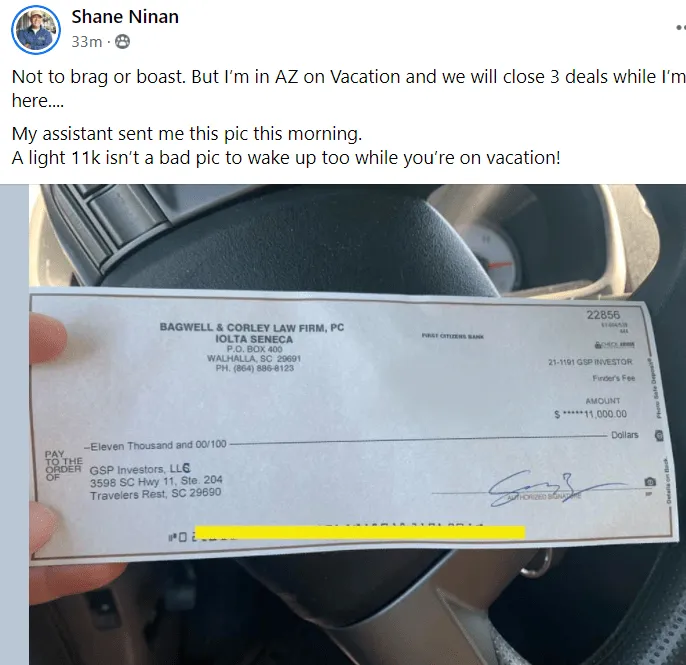
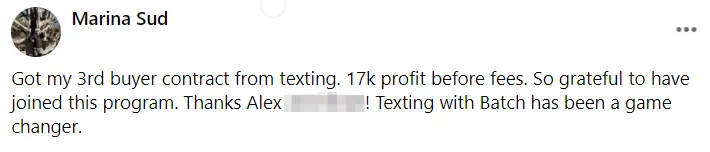
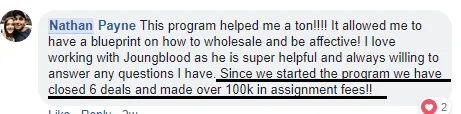
Here's What Others Have To Say


Frequently Asked Questions
Who is this for?
Two types of people. First: you're looking at automated trading systems right now — maybe your first, maybe your fifth — and you want to make the right choice before you commit real capital. You want to pick the one that's actually going to work, not the one with the best marketing page. Second: you've already been burned. You lost money to a system that looked legitimate, and you're not making that mistake again — but you still believe the right system is out there. Either way, if real money is about to go into an algorithmic trading system, this course exists so that decision is informed, not lucky.
Who is Brian Devens?
Brian is an institutional algorithmic systems researcher with seventeen years of experience across poker, systems engineering, professional trading, and hedge fund-level quantitative research. He was a semi-professional poker player at seventeen, earning six figures in a single year. He studied Systems Engineering at Virginia Tech — ranked Top 5 nationally — specializing in probabilistic and stochastic modeling, and was at one point ranked #1 out of 4,000 students in his engineering program. By his late twenties he was a professional eight-figure day trader controlling significant market positions alongside other eight- and nine-figure professionals. He's co-founded multiple eight-figure companies across industries and has spent the last seven years deep inside institutional algorithmic development — investing over $1 million, analyzing 64 billion+ data points, and working with a global team of quantitative researchers across four countries. His work has been independently audited by a CIPM-certified institutional verification firm — the same standard used by major hedge funds. Over the past two years alone, he estimates helping investors avoid over $27 million in potential losses through direct consultation, education, and exposing structurally broken products in this space.
What exactly is The Evaluator's Framework?
A six-step evaluation system that teaches you how to assess any automated trading system using the same structural criteria used by institutional allocators and professional quantitative researchers. It doesn't teach you to trade. It doesn't teach you to code. It doesn't teach you to build a system. It teaches you to see what a system is actually made of underneath its marketing — and to know, before you commit a dollar, whether it's structurally sound or carrying risk that hasn't activated yet.
How is this different from other trading courses?
It's not a trading course at all. That's the difference. Every other course in this space teaches you how to trade, how to read charts, or how to build strategies. This is the only course that teaches you how to evaluate the systems being sold to you. Three hidden risk types. Four false assurance mechanisms. Five business structure signals. A complete checklist you can apply to any system. Nothing like it exists at the retail level — because the criteria inside it has only ever lived inside institutional research until now.
I already have a system I'm looking at. Is this still worth it?
Especially then. One investor who went through the framework found that his top three picks — the systems he was most excited about — became his three worst under evaluation. The red flags were obvious once he had the tools to see them. If you're about to commit capital to anything, run it through this framework first. It takes minutes. What it could save you is a number you don't want to learn the hard way.
Is there a guarantee?
Yes. Go through The Evaluator's Framework. Apply the six steps to any system you're currently considering. If it doesn't completely change the way you see and evaluate algorithmic trading systems — if you don't walk away with a level of clarity about this space that you've never had before — email us within 30 days. Full refund. You keep the course and all three bonuses.
You're not risking anything by going through this course. You're risking everything by making your next investment decision without it.
Download The Evaluator's Framework
$7.00
(Save $631.00 today)
Enroll In This Program For $638 Only $7.00! Delivered instantly. Start implementing in the next 2 minutes.
Available For Instant Access
Reviews
Included Bonuses
BONUS #1: The Evaluator's Checklist Cheat Sheet
The complete 29-item structural evaluation in a single print-ready reference document. Every check. Every risk category. Plain-language descriptions. Mark it as you go.
BONUS #2: The Vendor Communication Guide
Complete call scripts, five copy-paste email templates, response evaluation framework, and the mindset guide that gives you the confidence to ask any vendor any question — professionally, clearly, and without confrontation.
BONUS #3: The Algo Evaluator Scorecard
Interactive digital tool. All 29 checklist items scored in real time with risk-weighted analysis, course-grounded explanations for every flag, and vendor questions surfaced for every unresolved item. Your complete evaluation in one place.
BONUS #4: The Evaluator's Calculator Suite
Seven interactive calculators that show you the math behind every decision — fragility analysis, loss clustering stress tests, Sharpe ratio benchmarking, track record confidence scoring, and more — without requiring you to know any math. Real numbers. Real-time results. Real clarity.

Video Testimonials
Get The 30-Day Deal Challenge

$5.60
(Save $31.40 today)
Download The eBook For $37 Just $5.60! Delivered instantly. Start reading in the next 2 minutes.
Available.
You're also getting..
Exclusive Video Training
$700,000 Website Template
Quickstart PDF Guide
2 Hour Agency Community
7 Day Fast Start Video Series

JOIN FOR ONLY $7.00
(Save $631.00 today) Grab the Evaluator Framework Now For $638 ONLY $7.00
Start reading in the next 2 minutes.
Here's Everything You're Getting Today:

BONUS #1: The Evaluator's Checklist Cheat Sheet
The complete 29-item structural evaluation in a single print-ready reference document. Every check. Every risk category. Plain-language descriptions. Mark it as you go.
BONUS #2: The Vendor Communication Guide
Complete call scripts, five copy-paste email templates, response evaluation framework, and the mindset guide that gives you the confidence to ask any vendor any question — professionally, clearly, and without confrontation.
BONUS #3: The Algo Evaluator
Scorecard
Interactive digital tool. All 29 checklist items scored in real time with risk-weighted analysis, course-grounded explanations for every flag, and vendor questions surfaced for every unresolved item. Your complete evaluation in one place.
BONUS #4: The Evaluator's Calculator Suite
Seven interactive calculators that show you the math behind every decision — fragility analysis, loss clustering stress tests, Sharpe ratio benchmarking, track record confidence scoring, and more — without requiring you to know any math. Real numbers. Real-time results. Real clarity.

Real Estate Business Audit
The Real Estate Business Audit is a comprehensive analysis of your current investing strategy and capabilities that reveals specific action steps you need to take to scale your deals for maximum profits.

STILL NOT SURE?
Frequently Asked Questions
Who is this for?
Two types of people. First: you're looking at automated trading systems right now — maybe your first, maybe your fifth — and you want to make the right choice before you commit real capital. You want to pick the one that's actually going to work, not the one with the best marketing page. Second: you've already been burned. You lost money to a system that looked legitimate, and you're not making that mistake again — but you still believe the right system is out there. Either way, if real money is about to go into an algorithmic trading system, this course exists so that decision is informed, not lucky.
Who is Brian Devens?
Brian is an institutional algorithmic systems researcher with seventeen years of experience across poker, systems engineering, professional trading, and hedge fund-level quantitative research. He was a semi-professional poker player at seventeen, earning six figures in a single year. He studied Systems Engineering at Virginia Tech — ranked Top 5 nationally — specializing in probabilistic and stochastic modeling, and was at one point ranked #1 out of 4,000 students in his engineering program. By his late twenties he was a professional eight-figure day trader controlling significant market positions alongside other eight- and nine-figure professionals. He's co-founded multiple eight-figure companies across industries and has spent the last seven years deep inside institutional algorithmic development — investing over $1 million, analyzing 64 billion+ data points, and working with a global team of quantitative researchers across four countries. His work has been independently audited by a CIPM-certified institutional verification firm — the same standard used by major hedge funds. Over the past two years alone, he estimates helping investors avoid over $27 million in potential losses through direct consultation, education, and exposing structurally broken products in this space.
What exactly is The Evaluator's Framework?
A six-step evaluation system that teaches you how to assess any automated trading system using the same structural criteria used by institutional allocators and professional quantitative researchers. It doesn't teach you to trade. It doesn't teach you to code. It doesn't teach you to build a system. It teaches you to see what a system is actually made of underneath its marketing — and to know, before you commit a dollar, whether it's structurally sound or carrying risk that hasn't activated yet.
How is this different from other trading courses?
It's not a trading course at all. That's the difference. Every other course in this space teaches you how to trade, how to read charts, or how to build strategies. This is the only course that teaches you how to evaluate the systems being sold to you. Three hidden risk types. Four false assurance mechanisms. Five business structure signals. A complete checklist you can apply to any system. Nothing like it exists at the retail level — because the criteria inside it has only ever lived inside institutional research until now.
I already have a system I'm looking at. Is this still worth it?
Especially then. One investor who went through the framework found that his top three picks — the systems he was most excited about — became his three worst under evaluation. The red flags were obvious once he had the tools to see them. If you're about to commit capital to anything, run it through this framework first. It takes minutes. What it could save you is a number you don't want to learn the hard way.
Do I need a math background or trading experience?
No. The course was built specifically for investors who are not quant researchers. The most important concept in the entire course can be understood in under five minutes. The equation that changes how you evaluate every win rate takes about sixty seconds. If you can compare two numbers, you can apply this framework. Everything is taught in plain language, step by step, with no assumptions about your background.
What if I'm completely new to algorithmic trading?
Then your timing is perfect. Most investors learn these lessons after they've already lost money. You have the chance to learn them before you've committed a dollar. The framework works whether you've been evaluating systems for years or whether this is the first time you've ever looked at one. In fact, some of the strongest results come from people evaluating their very first system — because they haven't built the wrong habits yet.
How long does it take to go through?
The course is six sections deep with real substance — this isn't a thirty-minute overview. But the tools start working immediately. The first concept alone changes how you see every equity curve in this space. And once you've been through the full framework, applying it to any new system takes minutes. Some systems fail the evaluation in twenty seconds.
Will this tell me which specific system to buy?
The framework teaches you how to evaluate any system — it doesn't recommend a specific one. But here's what actually happens: once you run several systems through the six steps, the answer becomes obvious on its own. Most of what's out there fails quickly. The short list of systems that pass the full evaluation is very short. You won't need someone to tell you which one to pick. You'll see it clearly.
Is there a guarantee?
Yes. Go through The Evaluator's Framework. Apply the six steps to any system you're currently considering. If it doesn't completely change the way you see and evaluate algorithmic trading systems — if you don't walk away with a level of clarity about this space that you've never had before — email us within 30 days. Full refund. You keep the course and all three bonuses.
You're not risking anything by going through this course. You're risking everything by making your next investment decision without it.
Brian is an institutional algorithmic systems researcher with seventeen years of experience across poker, systems engineering, professional trading, and hedge fund-level quantitative research. He was a semi-professional poker player at seventeen, earning six figures in a single year.
He studied Systems Engineering at Virginia Tech — ranked Top 5 nationally — specializing in probabilistic and stochastic modeling, and was at one point ranked #1 out of 4,000 students in his engineering program.
This product is brought to you and copyrighted by Algo Evaluator
We can not and do not make any guarantees about your ability to get results or earn any money with our ideas, information, tools, or strategies. What we can guarantee is your satisfaction with our training. We give you a 30-day 100% satisfaction guarantee on the products we sell, so if you are not happy for any reason with the quality of our training, just ask for your money back. You should know that all products and services by our company are for educational and informational purposes only. Nothing on this page, any of our websites, or any of our content or curriculum is a promise or guarantee of results or future earnings, and we do not offer any legal, medical, tax or other professional advice. Any financial numbers referenced here, or on any of our sites, are illustrative of concepts only and should not be considered average earnings, exact earnings, or promises for actual or future performance. Use caution and always consult your accountant, lawyer or professional advisor before acting on this or any information related to a lifestyle change or your business or finances. You alone are responsible and accountable for your decisions, actions and results in life, and by your registration here you agree not to attempt to hold us liable for your decisions, actions or results, at any time, under any circumstance. (For educational purposes and we do not promise any sort of financial gain from the tools)